Editor’s note: On 17 January 2016, Rohith Vemula, a Dalit PhD scholar at the University of Hyderabad (UoH), was found hanging in his hostel room. The university had earlier suspended Vemula, who was a member of the Ambedkar Students’ Association (ASA), for allegedly assaulting a member of the right-wing Akhil Bharatiya Vidyarthi Parishad (ABVP). Around six months before his death, UoH stopped paying his monthly stipend, a step that his friends allege was directly linked to his anti-Caste activism under the ASA’s banner. Notably, his suspension came after then Bharatiya Janata Party (BJP) Member of Parliament from Secunderabad and minister in the union cabinet, Bandaru Dattatreya, wrote to his colleague, Union Minister for Human Resource Development (HRD), Smriti Irani, accusing Vemula and his friends for “casteist, extremist and anti-national politics.”
17 January 2016 marked a new phase in the student politics of India by bringing Caste into the center of popular debate. The only two times when Caste had acquired some space in student politics was during the Mandal Commission agitation in the 1990s, and the Other Backward Caste (OBC) reservation implementation in higher education in the year 2007.
However, during the last two times, despite the large scale political implications involving the central governments, it largely impacted the student politics only in and around Delhi. It made waves in few other campuses, but as a whole, they were scattered and isolated.
In Delhi, the ‘reserved versus deserved’ debate had become one about Dalit-Bahujan students versus forward Caste students, with most news channels supporting the latter. It cracked open the fault lines of Indian Caste societies among students that existed since forever. But one important reason why it couldn’t spread out into a countrywide co-ordinated mobilization by Dalit-Bahujan students was also due to the little or no use of social media.
But this time was different. What transpired with Rohith and his friends over months and the imageries of Velivada (Dalit Ghetto) during his last days, spread like wildfire among Dalit-Bahujan students across campuses through social media. Earlier too, there had been a series of institutional murders of Dalit students, which were met with outrage, but this time it could not be contained.
The mobilisations following Vemula’s death became the first large-scale resistance against Prime Minister Narendra Modi since he came to power in 2014. This also set a precedent for how BJP could be resisted with similar mobilisations over the coming years.
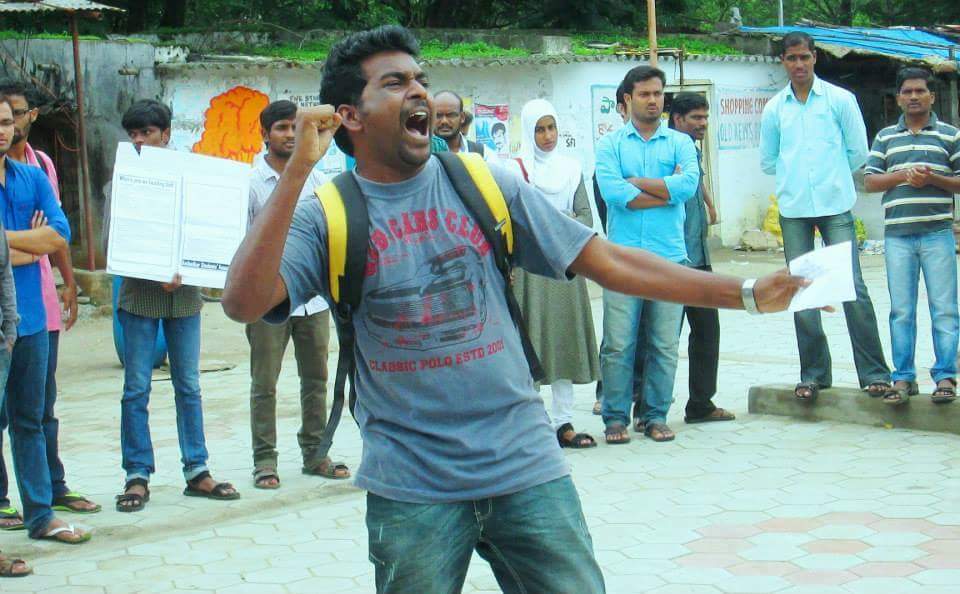
Dalit student and youth groups across the country started coming out into the streets and the presence of BAPSA in Jawaharlal Nehru University (JNU) made a difference in holding conversations around Rohith in Delhi. They started mobilising in the nearby Dalit colonies just the day after the tragic event.
The left groups in JNU campus were not so keen about the issue in the initial days until it blew up big in few weeks. These things matter because of the differential power equation among student groups as to who has access to the key networks to make any issue big. Caste is definitely a factor in this.
Five years have passed by since then, different sets of people continue to find their own meanings through the figure of Rohith Vemula and the mobilisations that followed with his enforced departure.
Starting from older generation of the anti-Caste movement, there was a section, which looked at this event as a wrong precedent for young Dalit students because it involved taking one’s own life. They merely looked at that last moment of Rohith. There was another section which kept emphasizing upon the isolating nature of Indian campuses for young Dalit students, which led to the loss of Rohith.
Also listen to our podcast ‘Why the Hathras Murder and Alleged Gangrape is Very Much About Caste‘
For a section of progressive higher Caste students and youths, the most important thing was the last letter which Rohith wrote. They tried to make it all about how poignant the letter was and his merit of being a brilliant writer. I still wonder what it would have meant for them without the last letter.
Would it have evoked the same emotions for an “unmeritorious Dalit student”? Would his figure still be venerated without that?
There was another group, a small section among them, which started taking it as a soul-searching moment of how oblivious they were about Caste around them, and started engaging on conversations around Caste and also with Dalit students.
For so many colleges and platforms, Caste became another topic they had to discuss in their events as some sort of a guilt-absolving exercise or to become part of the running trend. Dalit names would be invited among the many higher Castes just to fulfill a diversity recruitment criteria, without actually addressing the institutional Caste practices that would be inherent to those colleges and institutions.
In the digital marketplace, Dalit lives in the guise of Caste were made to become a commodity, nicely packaged to allure the youths, thus making Caste all about few Dalit lives. It almost seems as though Caste is some remote island and Dalits inhabit it, far away from the real world.
What did it mean for a large section of Dalit-Bahujan students and the anti-Caste student politics ?
For them, the Rohith Vemula movement became a gateway for political consciousness. The proliferation of Caste conversations on social media provided many the courage to articulate and a realisation that they were not alone. For so many of us who come from villages and small towns, Rohith meant more than just his fascination for cosmos and stars. He embodied if not similar, but our kinds of aspirations, emotional crises, a deep desire to convey what was suppressed, and to create one’s own space while also supporting fellow Dalit students with their needs.
So many out there look at abstraction as merely an intellectual stimulation or a tool for literary or artistic creation, while for many young Dalits coming from these kinds of location, it becomes an alternative reality of refuge besides the crude, harsh lives.

Rohith’s abstraction reminds of young jeep helpers (Dalit guys) from my place. With t-shirts inside, they would open the buttons of their shirts as the jeep would start rolling and standing on one side, their shirts would flow with the wind. During the whole journey, they would feel like Bollywood actors and elevate themselves into a different reality, escaping from the wretched feelings of being outcastes and their everyday crude lives. The only difference is Rohith studied science, was exposed to an university space and we lost him.
If ‘Educate, Agitate and Organise’ has been a defining motto of the anti-Caste movement, then the post-Rohith Vemula phenomenon made ground for the word “to associate” and the cultivation of fellow feelings, which Baba Saheb emphasized in his writings. It brought about a hitherto non-existent sense of interconnectedness among Dalit-Bahujan students and their organisations across campuses.
Also read ‘Caste in Liberal, Feminist Spaces in India‘
This politicisation, as non-uniform it might be, popularised the anti-Caste discourse, at least in social media. Yet, this had some adverse fallouts – such as absorbing oneself into engagements with individual penance for upper Castes rather than structural changes (a reflection of American liberal identity politics), subsuming nuanced and complicated local Caste histories with the generic Uttar Pradesh- and Maharashtra-centric understanding of anti-Caste movements, and nationalising Dalit and Bahujan category that would not serve the interests of local (linguistic, cultural and regional) politics of resisting the centralised Upper Caste dominations.
We need to remember that the Ambedkar Students Association in Hyderabad Central University (HCU) and Rohith Vemula movement bear the legacy of local, decades-long Dalit struggles of Telengana and Andhra with Karamchedu and Tsunduru massacres as the genesis of this political consciousness.
The essence of Rohith Vemula was autonomous and assertive, and not to compromise the discourse to seek a space among the ruling Castes. He stood for a politics of solidarity with other oppressed communities across the country while also keeping intact his desire to popularise subaltern and local Dravidian history against cultural chauvinism.
May we celebrate the life of Rohith for who he was – a human being – and his contribution to the anti-Caste movement as an organiser, thinker, writer and activist. We also need to remember Rohith’s mother, Radhika Vemula, and brother, Raja Vemula, for their lives and for all that they have been to so many young Dalit students for the last five years.
Views expressed are the author’s own.
Featured image credit: Ambedkar Students’ Association (ASA); arranged by the author.

is an anti-caste activist, scholar and hip-hop artist.